Early History of the Germantown Congregation
During
the 1680s, Mennonites and Quakers of Germantown worshipped together in the
homes of Tunes Kunders and others. But
in 1690, the Germantown Mennonites chose William Rittenhouse to be their
minister, and Jan Neuss their deacon. For unknown reasons, Rittenhouse felt unable
to supervise communition, so in 1702, Jacob Gottschalk and Hans Neuss were
ordained ministers to assist him.
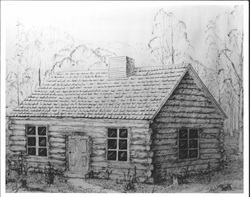
In 1708, the first Mennonite meetinghouse in the New World, a simple log cabin structure, was built on land that Arnold van Vossen deeded to the Meetinghouse (on the site of the present Meetinghouse). In May of that year, the first baptism service was held in the Meetinghouse with eleven candidates. Two weeks later, the first communion was held. 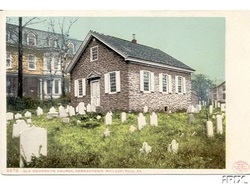
In 1712, Jacob Gottschalk had the Dordrecht Confession, a statement of beliefs adopted by Dutch Mennonite leaders in 1632, translated into English and printed. At this time, membership was recorded at 99 members. In 1725, the same Dordrecht Confession was adopted in Germantown at the first inter-Mennonite conference in America, declaring that nonresistance is expected of all followers of Christ. Conestoga (Lancaster) and Skippack (Franconia) delegates attended and affirmed the Confession.
In the 1740s, Christopher Sauer published the first European language Bible in America – Luther’s German translation. Colonial schoolmaster Christopher Dock taught summer school for four years in the Germantown meetinghouse. Pennsylvania Mennonites had the Martyr’s Mirror, an extensive compilation of stories and testimonies of Christian martyr’s, especially Anabaptists first published in Dutch in 1660, printed at the Ephrata (PA) Cloister. The translation from Dutch into German had been started in Germantown, and at the time of its printing, it was the largest single volume book published in America. 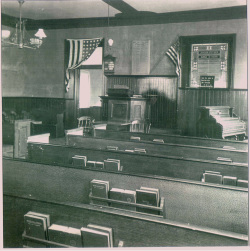
In 1770, the present meetinghouse was built of local Wissahickon schist stone for the 25 remaining members after half of the group had moved north to Skippack. Its builder was Jacob Knorr, a local master builder whose recent accomplishments included the Germantown Academy, Cliveden, and the Johnson House. Knorr became a member of the Mennonite meeting that same year, and was ordained as a minister. Also in 1770, the first American book on pedagogy was published in Germantown: Christopher Dock’s Hundred Necessary Rules of Conduct for Children.
In 1847, the Germantown congregation became a part of the newly-formed Eastern District Conference of the General Conference Mennonite Church, but in 1851 left the conference, calling itself the Reformed Mennonite Church of Germantown. In the 1860s, major changes were made to the sanctuary interior of the building: the present benches that are facing the north side of the building were installed, as was the raised pulpit. The American flag was also displayed. By 1876, the congregation re-affiliated with the Eastern District Conference of the Mennonite Church. In 1888, Daniel Kolb Cassel’s History of the Mennonites was published as the first Mennonite history book in America (Cassell is interred in the Germantown Mennonite Cemetery). In 1908, the Sunday School addition was completed on the rear of the Meetinghouse to accommodate a Sunday School program. In 1922 the Germantown Mennonite Church legally incorporated. |

Support provided in part by
|


Germantown Mennonite Historic Trust - 6133 Germantown Avenue, Philadelphia PA 19144 - (215) 843-0943 - [email protected]